

Following the president's criticism of sub-Saharan migrants, black women in Tunisia claim that incidents of racism have increased.
According to activist and black Tunisian Khawla Ksiksi, "In Tunisia people are constantly doubting the fact that I'm Tunisian.".
President Kais Saied imposed "urgent measures" on migrants from sub-Saharan Africa in February after accusing them of a "criminal plot" to alter the nation's demographics and cultural identity.
According to him, immigration originated from "a desire to make Tunisia just another African country and not a member of the Arab and Islamic world," continuing that it was the cause of immigration.
According to Human Rights Watch, since the statement, there has been an increase in violence against black African migrants, making the situation worse for black Tunisians, who make up between 10 and 15 percent of the country's population.
Some of those in this number are descended from slaves who lived in sub-Saharan Africa; the slave trade was outlawed in Tunisia nearly 180 years ago; whereas others can trace their ancestry much further back. .
According to Ms. Ksiksi, who spoke to the BBC, she is made to feel invisible: "They don't want me to be a part of Tunisia, so sometimes I speak in Arabic, and they respond in French. ".
The official language of Tunisia is Arabic, but Ms. Ksiksi claims that when she speaks it, she is frequently rejected because other people do not want to acknowledge a sense of kinship with her.
People who reply to her in French are making it clear that they do not believe she is Tunisian even though French is a language of privilege and education and is also the language of "outsiders.".
The Voices of Black Tunisian Women collective's co-founder, Ms. Ksiksi, wants to dispel the myth that there are no black Tunisians.
The 31-year-old says, "Even though Tunisia is so violent toward me [and people who look like me], I feel like I belong there.".
They treat us differently than Tunisians and treat themselves differently than Africans. ".
Although Tunisia gained independence from France in 1956, the author claims that the colonial stereotype that black Tunisians are "dusty and unclean" still exists.
This is the cause of Tunisia's severe identity crisis. On paper, we were independent, but colonial politics still prevail. ".
She thinks that the idea that there are no black Tunisian citizens is strengthened by the lack of black representation in positions of social and political power.
Black Tunisians, according to Ms. Ksiksi, "have to constantly prove that we are enough because my skin color suggests that I don't belong.".
She continues, "I had to always have the best grades in school because all the teachers thought I would cheat because in their eyes black people are not very intelligent. ".
The activist claims that although she had the financial means to pursue a quality education, this privilege frequently made her feel alone and excluded: "You're always the only black person in the room, which makes you feel excluded and on your own.
"I always have the impression that I am the black . in a world of white. ".
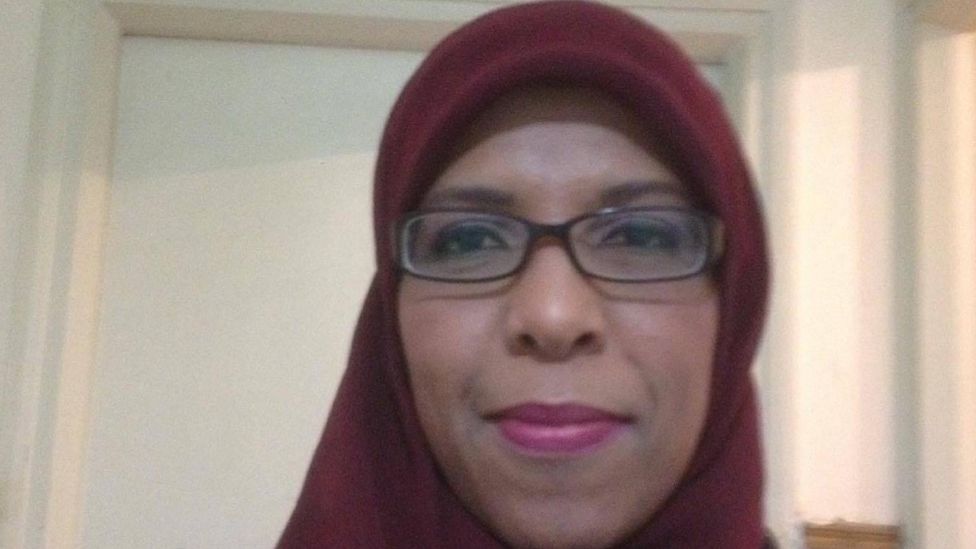
Houda Mzioudet agrees with Ms. Ksiksi that Tunisian society has been based on a "homogenized nationhood" that forbids the discussion of racism.
The 46-year-old academic researcher and lecturer claims that, rather than racism per se, what is more violent in Tunisia is the rejection of one's own horrifying experiences with racism.
A trend on Facebook called "Carrying My Papers Just In Case" was started by some black Tunisian women in response to the president's remarks, including Ms. Mzioudet.
They displayed their passports and other forms of identification prominently on their clothing to identify themselves as Tunisians and to show support for migrants.
Ms. Mzioudet was raised in the country's south, where she saw a "de facto form of slavery and apartheid" in the 1980s, despite the fact that she was born in Tunis, the nation's capital.
Although it was outlawed in Tunisia in 1846, the slave trade, which involved buying and selling black Africans, still has an impact today.
The Tunisian Arabic word for a black person is "wessif," which means "servant," according to Ms. Mzioudet. However, domestic slavery has continued, and black people are now referred to as servants rather than slaves.
Despite coming from a wealthy family, she discovered at school that black women's career expectations typically included singing or dancing — "or something like prostitution.".
"It was very difficult for me to emancipate myself from that picture growing up in a culture where black women have always been objectified and sexualized," she says.
According to Ms. Mzioudet, the president's remarks regarding sub-Saharan migrants were a reaction to the Arab Spring and what it meant for black Tunisians.
A record-breaking wave of street protests forced long-serving President Zine al-Abidine Ben to leave the country in 2011. After decades of dictatorship, democracy was subsequently introduced, giving black Tunisians the chance to become visible in society.
As more black Tunisians began to demand equal treatment, Ms. Mzioudet felt more at ease identifying as black.
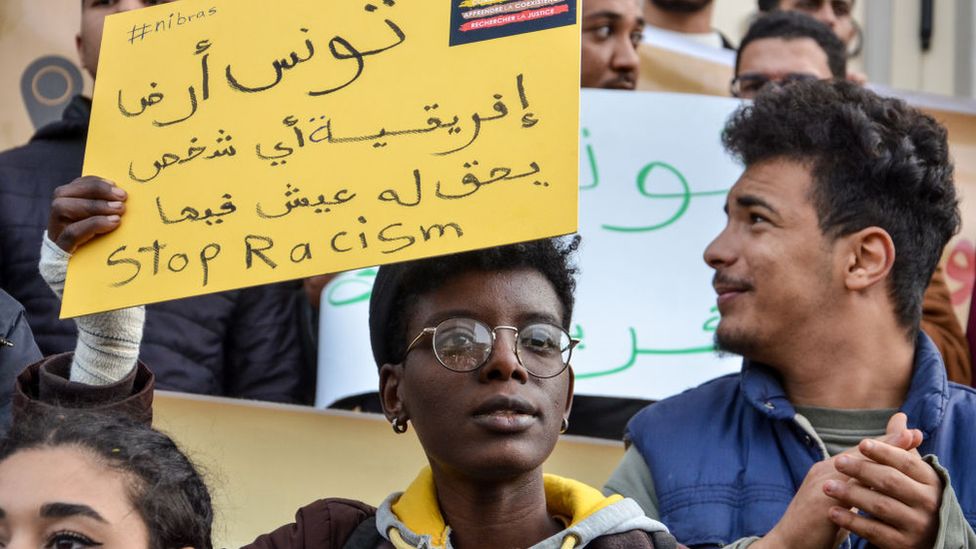
In order to make racial discrimination, particularly anti-black racism directed at black migrants from Africa and black Tunisians, illegal, Tunisia passed a landmark law in 2018. It became the first Arab nation in the region to criminalize discrimination based solely on race.
Both Ms. Ksiksi and Ms. Mzioudet assert that the government has permitted the prejudice and inequality experienced by black Tunisians to flourish despite these laws.
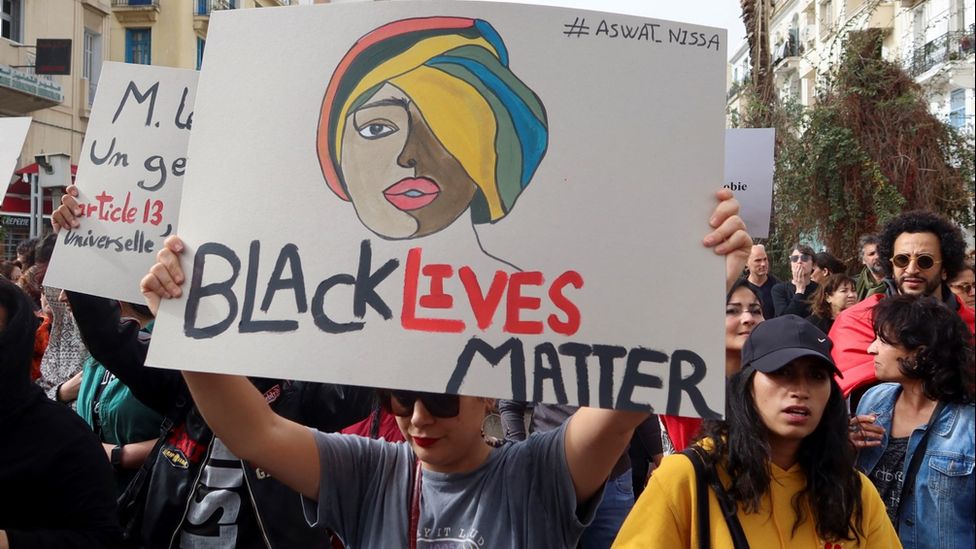
According to Ms. Mzioudet, the fact that hundreds of people marched through Tunis in February in support of black African migrants and black Tunisians is encouraging and shows that the younger generation wants change.
She says that one of the largest marches in downtown Tunis, which was primarily comprised of non-black Tunisians who were expressing the sentiment that black lives matter, brought her to tears.
Furthermore, it is a human rights issue rather than a black issue.
. "