
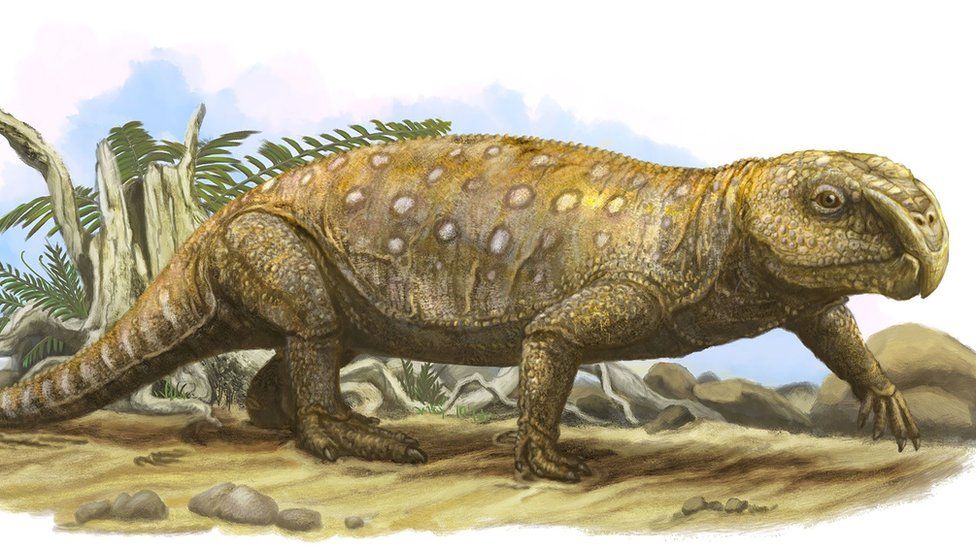
A sheep-sized dinosaur that consumed hard plants and trees may have lost its teeth as a result of its diet, according to new research.
Rhynchosaurs may have starved to death in old age, according to University of Bristol researchers who examined specimens from Devon.
Between 225 and 250 million years ago, during the Triassic Period, the herbivorous reptile inhabited the planet.
It was a time when a lot of warm weather and hardy plants existed.
The scientists used scans to observe how the animals' teeth changed with feeding and how new teeth were added as they grew larger.
The study's team leader, Prof. Mike Benton, said he was "amazed" to discover that animals frequently "dominated their ecosystems.".
The antelopes or sheep of their time, he continued, "yet they had specialized dental systems that were apparently adapted for dealing with tons of tough plant food.".
The Devon fossils were found by Dr. Rob Coram, who said the study indicated the animals may have had trouble getting enough nutrition after their teeth eventually became worn down.
Although individuals were occasionally buried during river floods, he noted that fossils were uncommon.
"This has allowed us to put together a series of jaw bones from rhynchosaurs that ranged in age from quite young, perhaps even babies, through adults, and including one particularly old animal, a Triassic old-timer whose teeth had worn right down and probably struggled to get enough nutrition each day. ".
As the animal grew older, new teeth and new bone began to wear, according to Thitiwoot Sethapanichsakul, who also examined the bones.
"They were eating really tough food like ferns that wore the teeth and bone down to the bone of the jaw," he said. "This means that they were basically chopping their meals by a mix of teeth and bone.".
Dr. Coram noted that the research suggested that as time went on, the emergence of new teeth slowed and the worn area "got deeper and deeper.".
Elephants of today have a fixed number of teeth that emerge from the back; once they reach their final tooth, which typically occurs around the age of 70, that's it, the speaker said.
"We don't believe the rhynchosaurs lived that long, but their plant food was so difficult that their jaws just wore out, and it's likely that they eventually starved to death. ".
Rhynchosaurs from Devon and later specimens from Scotland and Argentina were compared by researchers with earlier specimens.
They were able to demonstrate how their distinctive dental features allowed them to diversify twice, first in the Middle Triassic and then in the Late Triassic.
However, in the end, it appears that climate change, particularly changes in the types of plants that were available, allowed the dinosaurs to take over as the rhynchosaurs went extinct.
The results are presented in the journal of palaeontology.