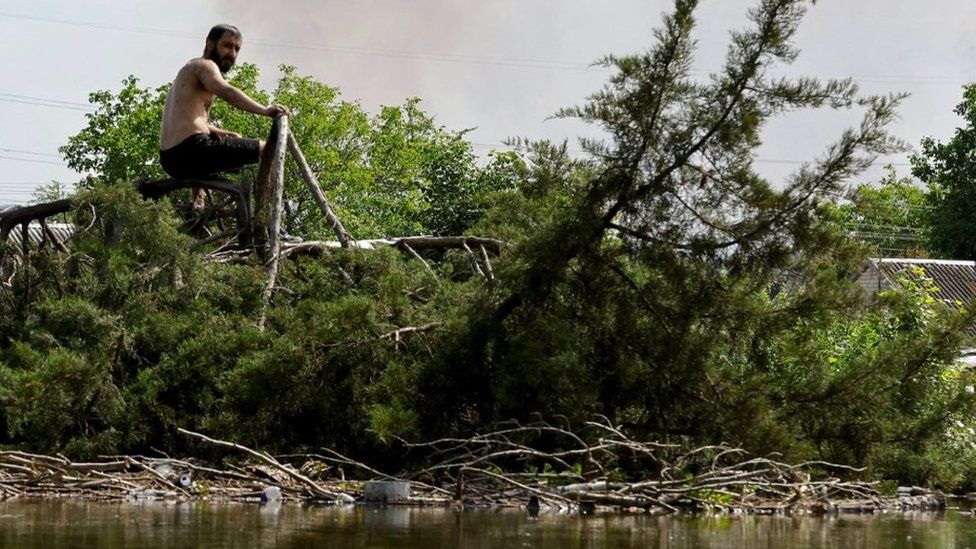
With flooded homes and displaced residents, the immediate humanitarian effects are dramatic enough.
Officials in Ukraine are now cautioning, however, of serious long-term effects on agriculture in one of the most fertile regions of the nation.
According to a warning issued by the agriculture ministry on Wednesday, fields in southern Ukraine could "turn into deserts as early as next year" if the crucial irrigation systems that rely on the enormous Kakhovka reservoir stop working.
It is estimated that 4 point 4 cubic miles of water are rushing down the Dnipro River and into the Black Sea as the reservoir rapidly disappears.
31 irrigation systems, according to the ministry, supplied water for 584,000 hectares (more than 2,200 sq miles) of farmland before the war.
According to First Deputy Minister Taras Vysotsky, "the dam was the only source of water for irrigation.".
"In order for us to take this water and deliver it, the dam and the pumping station inside of it were necessary. Now, that is gone. Water lines should be built from scratch if they are to serve farmers. ".
The Kherson region is one of the most productive and fertile in all of Ukraine.
Aside from its famed watermelons, the fertile farmland on either side of the Dnipro River produces a wide range of other crops, including wheat, sunflowers, soybeans, onions, and tomatoes. Additionally likely to be impacted are dairy farms.
Some of the worst effects might be felt in the parts of Ukraine that Russia has occupied, including Crimea, which it annexed in 2014.
Significantly more flooding occurs along the Dnipro's southern shore, which is under Russian control, than along its northern shore, which is under Ukrainian control.
Further away, the dry peninsula of Crimea, which heavily relies on Dnipro water, could completely run out of supplies.
Just above the dam, at Nova Kakhovka, a canal that transports water to Crimea exits the river. No water is likely to reach the canal after the reservoir has been drained.
In order to support their argument that Ukraine, not Russia, was responsible for the collapse of the dam, Russian officials claim that the flow along the canal has already decreased significantly.
Such claims need to be taken with a grain of salt given Moscow's track record of lying about almost every aspect of the war thus far.
How long will it take for this catastrophe to happen?
The enormous water flow through the damaged dam is still being evaluated by officials. It's likely that a reservoir that was initially built in 1956 after the dam and nearby hydroelectric plant were finished will once again be a river in a few weeks.
It is difficult to calculate the cost of several years of relying solely on rainfall without sufficient irrigation. However, according to Mr. Vysotsky, the amount would probably be in the range of $1 billion and $10.5 billion (£800 million to £1.02 billion).
He informed me that "repairing [the dam]" or starting over from scratch could take up to five years. Therefore, we can estimate that the sector would lose about $7 billion if we lose $1.15 billion over a five-year period.
International markets have taken notice even before the current losses' cost has been determined. The flooding played a part in the sharp increase in wheat prices around the world.
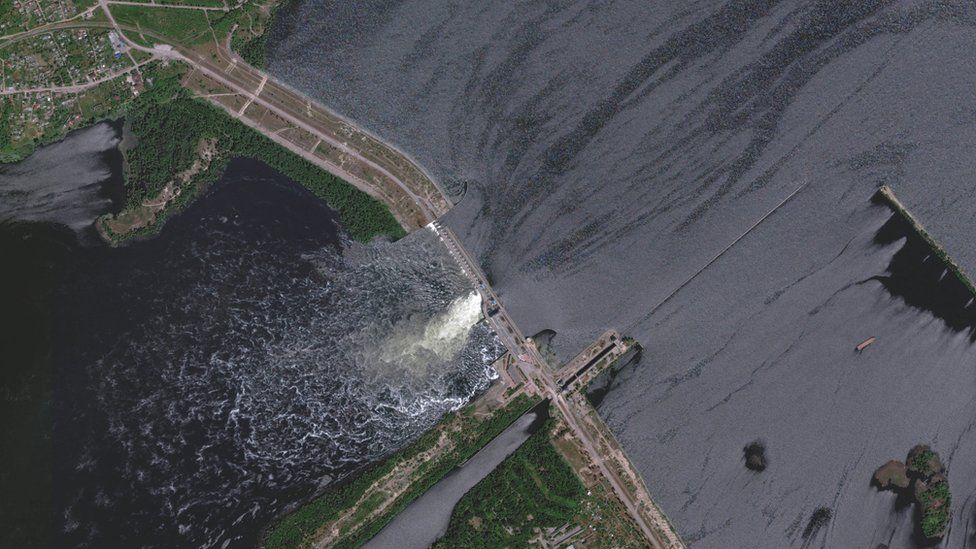
However, this man-made catastrophe will have an impact on sectors other than agriculture.
The agriculture ministry said in a statement this morning that without the reservoir, "Not only farmers and water users will suffer, but also the sources of drinking water supply in populated areas. ".
In towns and villages where the taps have run dry, authorities are frantically trying to find a way to supply potable water.
Pollution is another effect of the flooding that locals along the swollen river are already beginning to notice and smell.
Tons of engine oil and other chemicals were dumped into the raging water when the hydroelectric plant and dam collapsed.
Sofia Sadogurska, a climate and policy expert at the civil society organization Ecoaction Ukraine, told the BBC that although it will take weeks to fully comprehend the effects, it is already clear that pollution levels in the area are very high.
both from nearby secondary pollutants and the hydroelectric power plant itself. Each city has a separate sewage system. ".
It was referred to as "an environmental bomb of mass destruction" by the president of Ukraine, Volodymyr Zelensky. The nation's prosecutor general's office announced that it was looking into a potential case of "ecocide.". ".
Ukrainian officials have responded to this most recent setback with a grim resignation after more than a year of horrors brought on by Russia's unprovoked invasion.
Mr. Vysotsky declared, "The entire war is a disaster.". Sadly, since February 2022, we have experienced disasters. From the smallest to the largest possible locations.
. "