The message the country had been praying for came over army radios on Friday in the middle of the Colombian jungle, in the dead of night: "Miracle, miracle, miracle, miracle. " .
Four children who had been missing for 40 days in the jungle were discovered to be alive, according to military code.
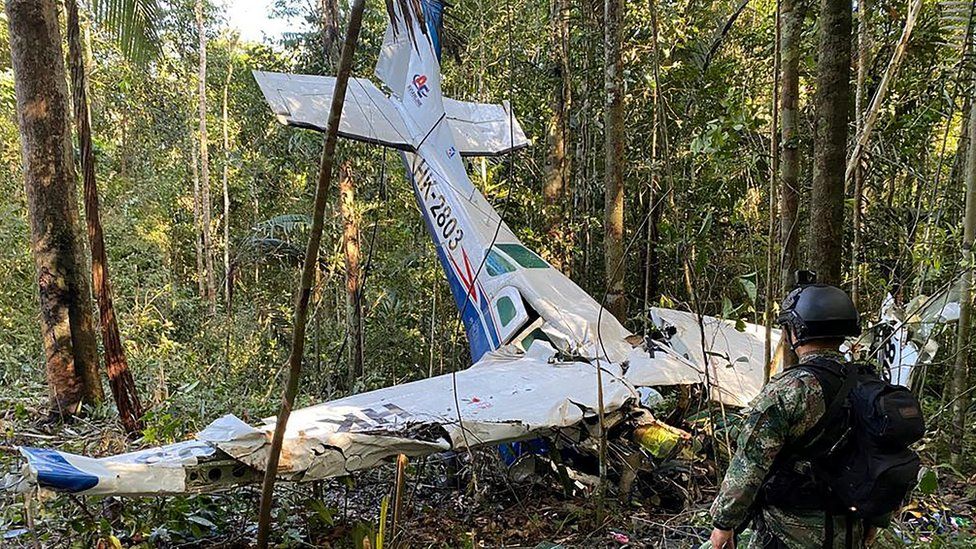
The children, who are all indigenous Huitoto people, have been missing since the light plane carrying them crashed into the Amazon on May 1st, early in the morning.
Children aged 13, 9, 4, and 1 were left alone in a dangerous area full of snakes, jaguars, and mosquitoes after their mother was killed in the tragedy.
The children may still be alive after they fled the crash site in search of assistance, rescuers soon realized after finding footprints, partially eaten wild fruit, and other clues.
In what Colombian President Gustavo Petro called "an example of total survival which will remain in history," the kids fought the elements and the odds over the course of the following six weeks.
The Mucutuy family were the best-equipped kids ever to handle such a challenge.
The eldest children, Lesly and Soleiny, were well versed in the jungle, according to their grandfather Fidencio Valencia, who told reporters that Huitoto people learn to hunt, fish, and gather from a young age.
The children's aunt, Damarys Mucutuy, revealed to the media in Colombia that the family used to regularly play a "survival game" together as kids.
"We set up like little camps when we played," she recalled. She went on to say that Lesly, who was thirteen, "knew what fruits she can't eat because there are many poisonous fruits in the forest.". She was also capable of caring for a child.
Lesly constructed temporary shelters out of branches that were connected by her hair ties after the crash.
She also found Faria, a kind of flour, in the wreckage of the Cessna 206 aircraft they were flying in.
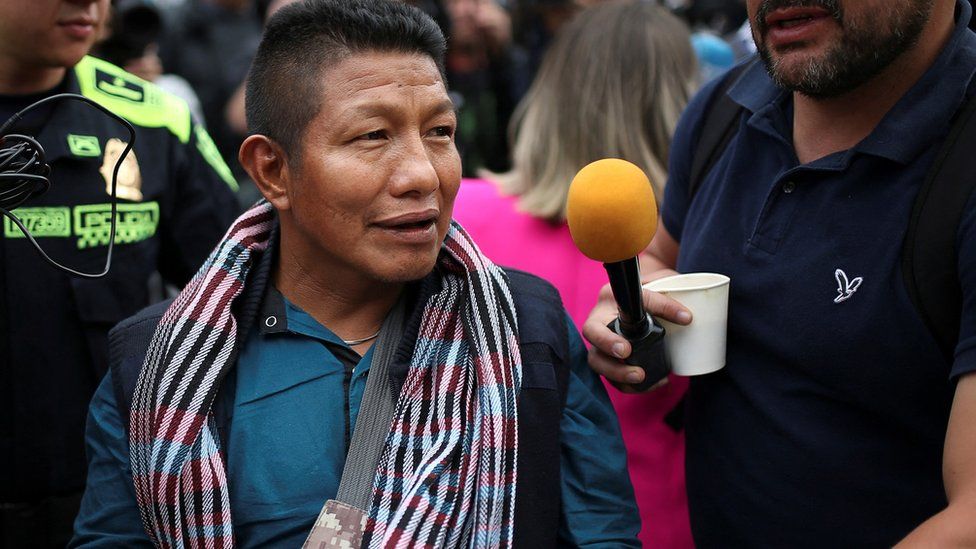
Edwin Paki, one of the indigenous leaders who participated in the search effort, told reporters that the children subsisted on the flour until it ran out and then they ate seeds.
He explained that there is a fruit called avichure that is similar to passionfruit. About a kilometer and a half away from the crash site, they were searching an avichure tree for seeds to eat. ".
The timing of their ordeal meant that they could eat fruit that was in bloom and "the jungle was in harvest," according to Astrid Cáceres, director of the Colombian Institute of Family Welfare.
However, surviving in the hostile environment remained a significant challenge for them.
The children were in "a very dark, very dense jungle, where the largest trees in the area are," according to indigenous expert Alex Rufino, who was speaking to BBC Mundo on Saturday.
He also cautioned that "others are poisonous," even though there are leaves the kids could use to purify water.
It is a region that has not yet been investigated. The towns are not in the jungle; rather, they are close to the river and are small.
The children had to avoid predators as well as ferocious downpours and perhaps even avoid armed groups that were rumored to be active in the jungle.
President Petro claimed that at one point a wild dog forced the kids to defend themselves.
However, Mr. Rufino pointed out that a 13-year-old raised in an indigenous community would already be familiar with many of the abilities necessary to succeed in such a setting.
The children were "raised by their grandmother," a well-respected indigenous elder, according to John Moreno, leader of the Guanano group in Vaupes, in the south-eastern region of Colombia, where they were raised. .
"They relied on their ancestors' knowledge to survive," he said. "They used what they learned in the community.".
Bogota officials came under fire for the slowness of the search as it went on. President Petro came under fire after his office misreported a tweet claiming the kids had been located.
To reassure the kids that they were being searched for, authorities dropped 10,000 leaflets with survival advice written in both Spanish and the Huitoto language of the native people. Helicopters also played messages from the kids' grandmother.
But the army was getting closer to finding the family, and the media was completely unaware of this. Several times, rescue teams came within 20 to 50 meters (66 to 164 feet) of the location where the kids were discovered, according to search commander Gen. Pedro Sánchez.
Around 150 troops and 200 volunteers from the area's indigenous groups were already working on the operation when the kids were found, and they were scouring a region that was more than 300 km2 (124 sq mi).
As the hunt progressed, Gen Sanchez told reporters, "This isn't a search for a needle in a haystack, it's a tiny flea in a vast carpet, because they keep moving.".
However, specialized rescue dogs located the kids on Friday after a month-long search.
The kids were seen being hoisted into a helicopter in the dark above the tall trees in a video posted by Colombia's defense ministry. They were transported by air to Bogota, the country's capital, where they were taken by ambulance to a hospital for additional medical care.
Despite the slim chances of survival, the family of the missing children thanked the army for continuing the search and pleaded with the government to return the kids as soon as possible.
"I never gave up; I always supported the investigation. The grandmother of the children told state media, "I feel very happy, and I thank President Petro and my "countrymen" who underwent so many difficulties.
The army's and volunteers' efforts were also praised by President Petro, who added that "this is the true path of peace" and praised "the meeting of knowledge: indigenous and military.".
He did, however, reserve special praise for the youngsters and their interaction with nature.
They were born in the jungle and are now citizens of Colombia, he said.
While the children's rescue has been hailed as a "miracle" by many in the deeply catholic country of Colombia, indigenous expert Mr. Rufino claimed that the true miracle was the children's "spiritual connection with nature.".
In addition to being green, the jungle also contains ancient energies that the populations interact with to communicate, learn from, and assist one another, he said.
"I know this is hard to comprehend, but this is an excellent chance for society, for people, to learn about the various worldviews that exist in the territories.
The same mother, who changed into a spirit following the accident, shielded them, he claimed. And now is the only time she will begin to rest. ".
Daniel Pardo from BBC Mundo contributed more reporting.