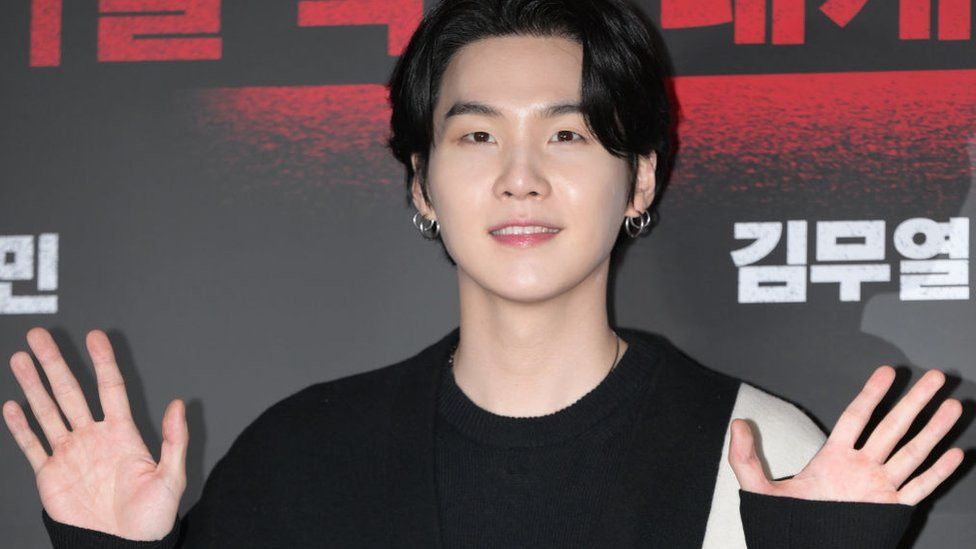
The struggle for South Korean musicians to perform in China has been discussed by a member of the K-pop supergroup BTS.
Suga acknowledged during a rare online livestream with fans that he "can't perform in China" because no Korean groups are permitted to perform there.
In light of rising tensions between the two neighbors, Korean media have attributed his remarks to China's unofficial "K-pop ban.".
Such limitations have never been acknowledged by Beijing.
Also uncommon has been for Korean celebrities to openly discuss the challenges they encounter when trying to sell their products in China.
However, when asked this week if he would be going on a solo tour of China, Suga responded, "How could I tour in China when we can't perform there?".
He further clarified: "K-pop groups still cannot perform in China as a whole, though members of other nationalities may go work there.
A worldwide concert tour is currently being performed by the 30-year-old, who also performs as August D.
In the past, South Korea's cultural industry's top export market was China. Since August 2016, however, only a very small number of South Korean celebrities have been able to perform in China, and Korean TV shows and movies have also largely vanished from the nation's theaters and TV screens.
Many South Korean companies have scaled back operations as a result of negative press in China.
South Korea filed a complaint with the World Trade Organization in 2017 to find out whether the Chinese government was treating South Korean businesses unfairly.
After the US installed its THADD missile defense system in South Korea in 2017, relations between the two nations deteriorated.
China was adamantly against the deployment, claiming it would upset the balance of regional security and give the US more access to its surveillance.
After Chinese President Xi Jinping and his South Korean counterpart President Yoon Suk-yeol met at the G20 summit last November, Seoul announced that a Chinese streaming platform had resumed distributing South Korean content after a halt of six years.
Beijing's Foreign Ministry also said at the time that China had never implemented the so-called "Korea ban", and China was open about conducting cultural exchanges with South Korea.
But relations between the two countries have gotten worse this year.
In April. South Korea summoned the Chinese Ambassador Xing Haiming over Beijing's criticism of President Yoon's remarks on Taiwan.
South Korea's leader had said in an interview that increased tensions around Taiwan were due to attempts to change the status quo by force, and he opposed such a change.
China's ambassador also drew fresh flak from President Yoon last week for suggesting South Korea had made the wrong decision for choosing to align with the US against China.
He had told a South Korean opposition leader that people who bet between US and China and think China will lose "would definitely regret" their choice.