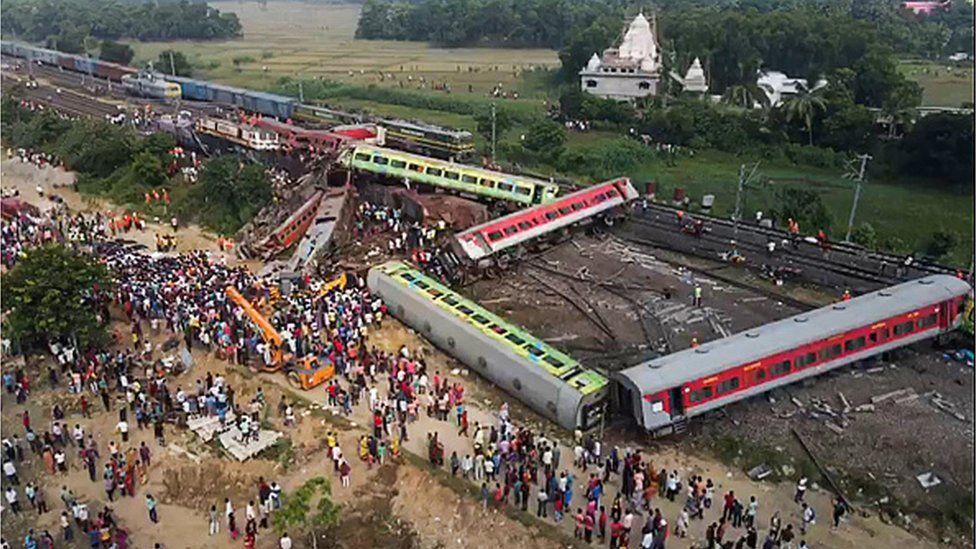
In the eastern Indian state of Odisha, three trains were involved in a terrible collision that claimed the lives of 261 people and injured hundreds more, many of them critically.
The crash, which is being called India's worst this century, has no known cause at this time.
The accident will be investigated by "a high-level committee," according to Railway Minister Ashwini Vaishnaw, who has visited the accident site.
The crash was attributed to "technical reasons," according to Mr. Vaishnaw's cabinet colleague Dharmendra Pradhan, who called it "an unfortunate incident. It should not have occurred.
According to an official, the commissioner of railway safety for the south-eastern circle, which includes the accident district of Balasore, will be in charge of the investigation.
Although the full circumstances of the accident are still unknown, the railway ministry reported that it occurred around 18:55 [13:25GMT] on Friday near the Bahanaga Bazar station, about 270 kilometers south of Kolkata and 170 kilometers north of Bhubaneswar, the capital of Odisha.
Three trains were involved in the accident:.
- The Coromandel Express, which was traveling to Chennai in the south, had just departed from the Shalimar train station in the West Bengali state just hours earlier.
- The nearly 35-hour Howrah Superfast Express journey had begun on Thursday evening at Bengaluru's Yesvantpur station and was scheduled to end on Saturday morning in Howrah, which is close to Kolkata.
- At the Bahanaga Bazar station, a stationary goods train was present.
The details of which train derailed first and how the collision occurred vary. However, the Coromandel Express was the train that derailed first, according to Railway spokesperson Amitabh Sharma.
"Roughly 10 to 12 of its coaches fell off the track and ended up on the opposite side. A short while later, the Howrah Superfast Express struck the flipped carriages, and three to four of its coaches also derailed.
Mr. Sharma did not mention the third train, but according to a press release from the state of Odisha, it was a "three-way accident" involving a stopped goods train. The two passenger trains' 17 coaches, according to the report, were severely damaged after derailing.
Three trains were allegedly involved in the collision, according to local villagers and accident witnesses.
According to Girija Shankar Rath, who lives close to the station and was among the first to arrive at the scene of the accident, the Coromandel Express derailed and struck the goods train that was parked on a nearby track from behind.
"There was complete chaos, and the region was covered in smoke. And then we witnessed the Shalimar Express crashing through some Coromandel wreckage and derailing two of its coaches, the man said.
Tutu Biswas, a different eyewitness, claimed he arrived at the accident scene after hearing a loud noise.
Mr. Biswas stated that "some of the Coromandel express coaches had gone over the goods train.". "There were numerous bodies and injured people present. A young boy I encountered had lost both of his parents. He died while crying, the speaker continued.
The accident on Friday ranks among the five deadliest ones in Indian railway history.
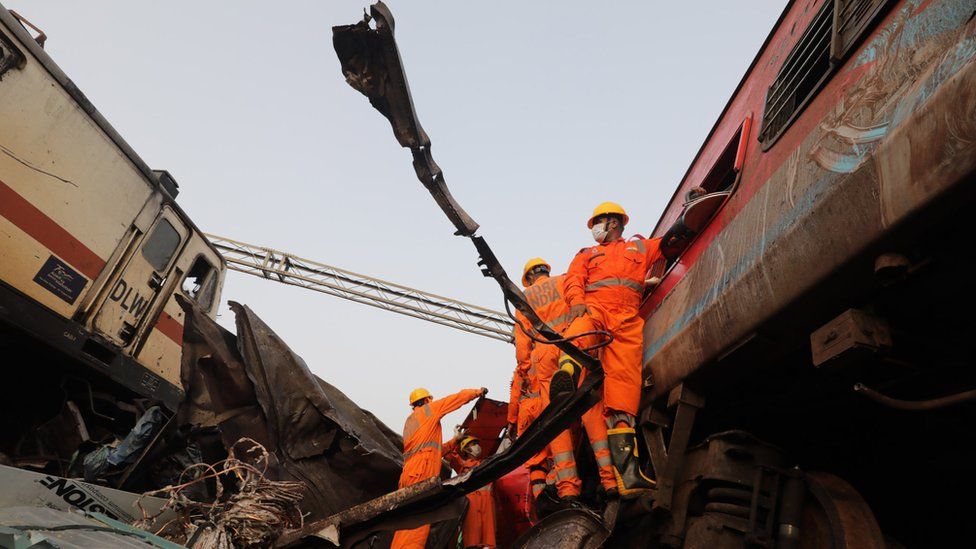
According to National Disaster Response Force (NDRF) Chief Atul Karwal, the force of the collision caused several coaches to be crushed and mangled, and rescue workers had to cut through the wreckage to get to the passengers.
Over a period of 18 hours, hundreds of ambulances, medical staff, nurses, and rescue workers worked to extricate bodies and free trapped passengers.
India has one of the largest train networks in the world; more than 12,000 passenger trains run through the country every day, carrying tens of millions of passengers. However, much of the railway infrastructure still needs to be improved.