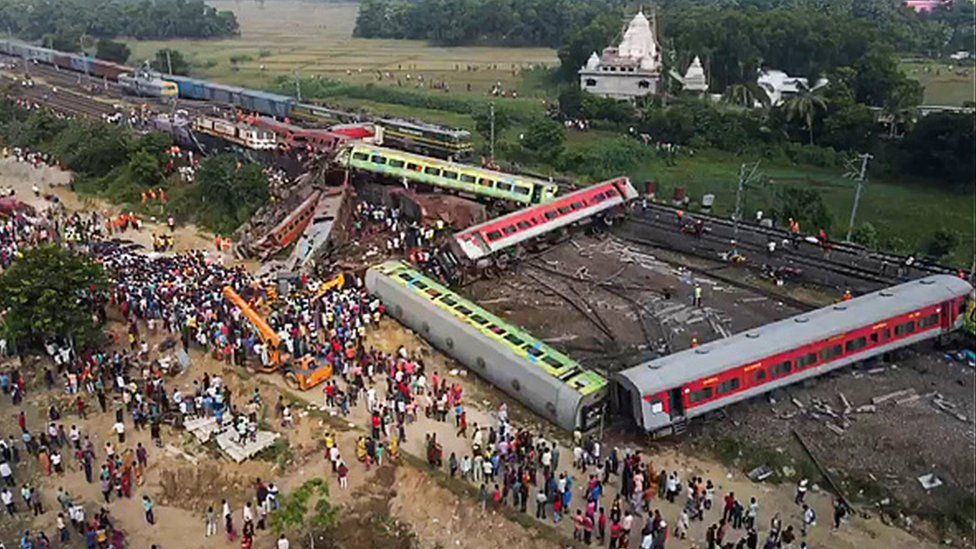
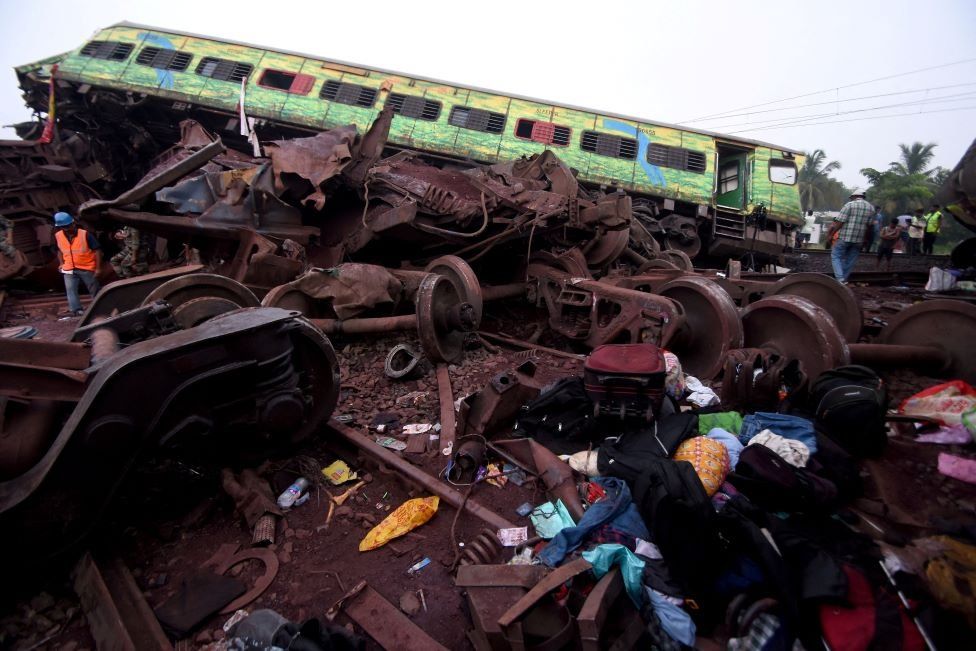
What specifically caused the deadly multiple train collision that injured 1,000 people and killed at least 261 people on Friday night in India is still a mystery.
Reports state that a "three-way accident" occurred near a small station in the eastern state of Odisha involving two high-speed passenger trains and a freight train. When one of them hit the stopped freight train, one of its coaches flipped over onto a third track, derailing an incoming train. Only a thorough investigation will be able to reveal the incident's true cause. However, it has sparked new worries about Indian railway safety once more.
With a nationwide network of tracks spanning more than 100,000km (62,000 miles), India's vast railway system—one of the biggest in the world—transports over 25 million passengers each year. According to Ashwini Vaishnaw, the railway minister, 5,200 km of new tracks were laid last year. According to the minister, 8,000 km of tracks are also upgraded annually.
Recently, Mr. Vaishnaw revealed in a conversation that most of the tracks were being upgraded to allow trains to travel at speeds of up to 100 kmph, a sizable portion was being enhanced for speeds of up to 130 kmph, and a sizable segment was being prepared for the high speeds of up to 160 kmph.
A high-speed line is being built between the financial capital of Mumbai and the city of Ahmedabad, so it is obvious that this is part of the government's plans to run faster trains across the country. .
Vivek Sahai, a former chairman of the railway board, told me that derailment is still a "bugbear for the railways.". A train can derrail for a variety of reasons, including "poor track maintenance, defective coaches, and driver error.".
Derailments caused 70 percent of the railway accidents, up from 68 percent the year before, according to a government report on rail safety for 2019–20. Next, train fires and collisions occurred, accounting for 14% and 8% of all accidents, respectively.
In the year under review, there were 40 derailments total, 33 involving passenger trains and seven involving freight trains. 17 of these derailments were the result of "defects" in the track; these include fractures and subsidence of the tracks.
According to the report, only nine instances of derailments were brought on by defects in train engines, coaches, or wagons.
Due to temperature variations, metal railway tracks experience expansion in the summer and contraction in the winter. They need routine upkeep, which includes things like tightening loose track parts, replacing sleepers, and lubricating and adjusting switches, among other things. The inspection of the tracks is done on foot, with trolleys, locomotives, and rear vehicles.
The Indian Railways advise that track recording vehicles thoroughly assess the structural and geometrical integrity of tracks intended to support speeds between 110kmph and 130kmph at least once every three months.
Federal auditors examined derailments between April 2017 and March 2021, and they found some alarming things.
- The report stated that there were "shortfalls ranging from 30% to 100% in inspections" by track recording cars necessary to evaluate the geometrical and structural conditions of the tracks.
- Two dozen "factors were responsible," according to a study of 1,129 investigation reports on derailment accidents.
- Derailments frequently occurred due to track maintenance (171 cases), then "deviation of track parameters beyond permissible limits.".
- There were more than 180 derailments that happened for mechanical reasons. Coach and wagon flaws were to blame for more than a third of them.
- The other significant contributing factor to derailments was "bad driving and over-speeding.".
Why the Coromandel Express derailed cannot be determined without an investigation. The installation of anti-collision devices on Indian trains has received a lot of attention, but a railway official claims that the system is currently only being installed on two significant routes: between Delhi and Kolkata and between Delhi and Mumbai.
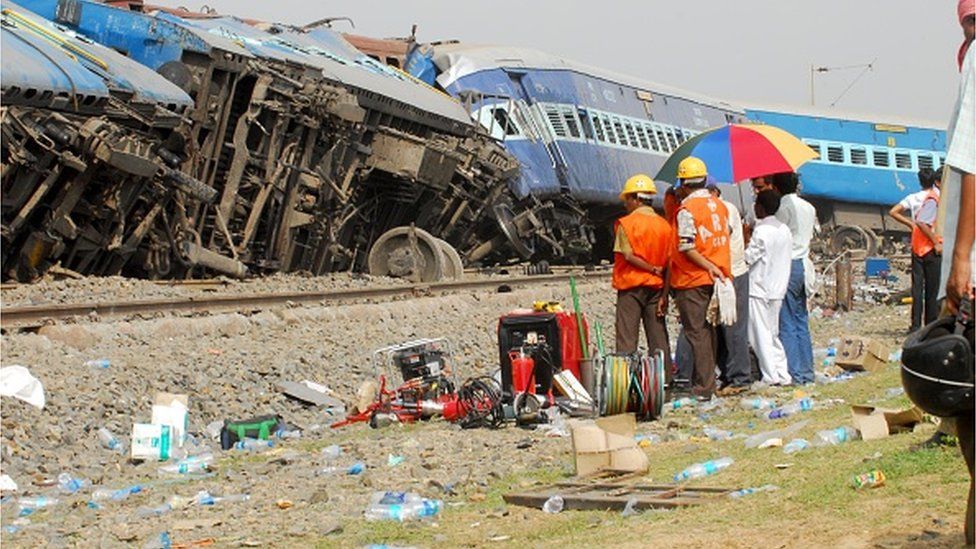
A passenger train derailed in West Bengal in 2010 and collided with an approaching freight train, killing more than 150 people. Investigators concluded that Maoist rebels had sabotaged the track, causing the passenger train from Kolkata to Mumbai to derailed and send five of its carriages straight into the path of the approaching fast trains. The accident on Friday has not yet shown any indication of sabotage.
The railways claim that during 2021–2022, there were 34 "consequential rail accidents," which include collisions, derailments, fires or explosions in trains, and road vehicles colliding with trains at level crossings, up from 27 such accidents the year before. On May 31, the Hindu newspaper reported that there were 48 such accidents in 2022–2023.
In a foresighted statement, the report stated that the railway authorities were concerned about the rising number of accidents and had asked their senior manager to "critically analyze long working hours of crew, especially in East Coast Railway and South East Central Railway, and take corrective action urgently.". The accident site was within the East Coast Railway zone on Friday night.
the YouTube channel for BBC News India. Go here by clicking. to subscribe and watch our explainers, features, and documentaries.