Following public input, a cable route has been selected to transmit electricity from an offshore wind farm to the national grid.
According to the Rampion 2 project team, a route is required to transport electricity from the new turbines off the coast of West Sussex to the network at Bolney.
The cables, according to the operator RWE, would be buried underground and the land would be restored to its prior state.
By 2030, if plans are approved, the wind farm might be in operation.
According to RWE, Rampion 2, an addition to the current windfarm that started operating in 2018, will be able to produce enough electricity to power the equivalent of over one million homes.
RWE's Chris Tomlinson stated that ongoing engineering and environmental assessments were combined with public feedback to drive consultations on alternative cable routes.
He said that for the portion of the route from Lyminster to Sullington Hill, the eastern route had been selected.
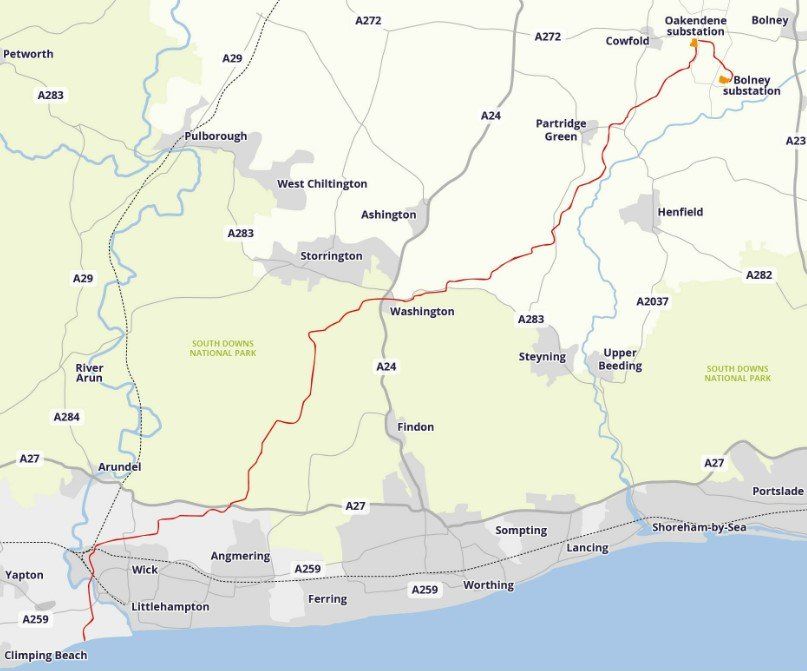
This was done primarily to protect the environment by staying away from Warningcamp Hill, New Down Local Wildlife Site, and ancient woodland.
The villages of Crossbush, Burpham, and Wepham also provided feedback, according to RWE.
Second, option 1d to rejoin the original route at Sullington Hill has been chosen for the northern end of the eastern route.
RWE claimed that this route was more direct, less disruptive to businesses, and affected fewer hedgerows.
Choosing a route that "meets the needs of local communities, wildlife, and the environment while providing an economic connection solution" had been the objective, according to Mr. Tomlinson, throughout the entire process. " .
RWE estimated that, should the project receive approval, construction would begin in 2026–2027 and that the wind farm would be fully operational by 2030.