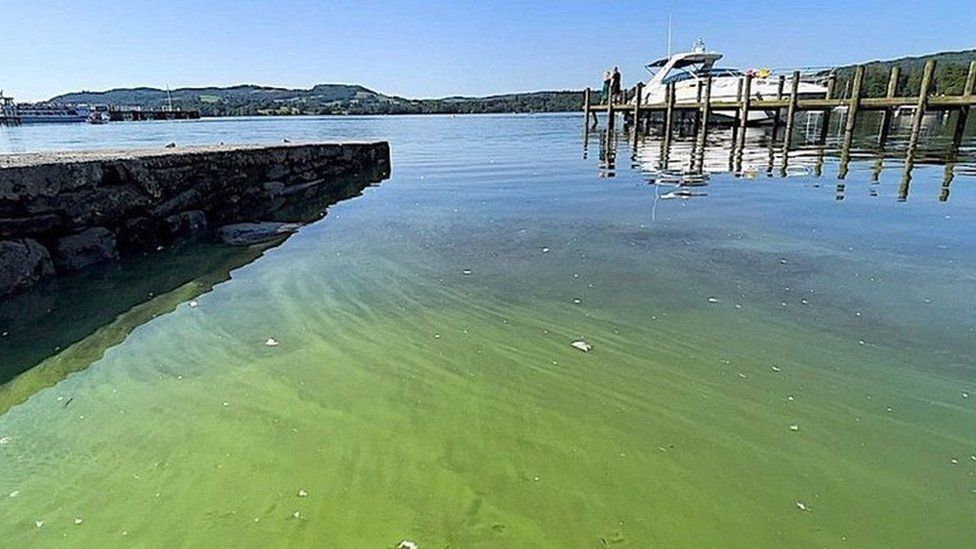
The largest lake in England has algal blooms, and people have been warned not to swim there and to keep pets away.
Warmer temperatures may cause harmful toxins to be released at Windermere in the Lake District, according to the Freshwater Biological Association (FBA).
Animals can die and people can get sick from blue-green algal blooms.
Prior to now, the Environment Agency declared its commitment to raising the lake's water quality.
Recent days have seen the appearance on social media of images of blue-green algae slicks in the lake.
Blooms are common in warm, dry weather and are made worse by nutrients from phosphate in pollutants like sewage, even though they happen naturally.
The FBA asserted that without thorough laboratory testing, it was unclear whether the reported blooms were producing toxins.
People and animals should still stay out of the lake if blue-green algae, also known as cyanobacteria, is present, according to Dr. Lynsey Harper of the FBA.

She explained that some cyanobacteria species have the ability to produce toxins that are dangerous for aquatic life, including humans and animals.
"Cyanobacteria do not always produce toxins, and even a particular species may not always do so.
"As a precaution, it is advised to avoid the water as well as to keep pets away from it. ".
Blooms can build up in sheltered bays or shorelines and are visible as scums or slicks on the water's surface.
Following reports of blooms in Windermere in 2022, zoologist Matt Staniek previously issued a warning that "people's health is being put at risk.".
Mr. Staniek, who led a campaign last month to stop sewage from being dumped into the lake, asserted that phosphate from United Utilities-owned sites was causing the blooms.
The heads of the Environment Agency claimed they had spent hundreds of thousands of pounds over the previous ten years to help with the problem.
United Utilities stated that it was aware of the issues and was dedicated to "playing its part" in reducing its impact on the lake.