Scotland hopes to be the first region of the UK to implement a deposit return program for single-use beverage containers. Ministers assert that it would increase recycling, but the proposal is divisive, with opponents calling for a postponement. What do we currently know about the scheme, and why is it drawing criticism?
To encourage people to recycle beverage containers like bottles and cans, deposit return schemes (DRS) are utilized in many nations around the world.
Older Scots will likely remember being able to get money back on their "ginger" (fizzy drink) bottles when they were kids; the process is the same today.
A small deposit is applied to any purchase of a beverage in a specific single-use container; this deposit is then refunded when the bottle or can is brought to a recycling location.
The goal is to encourage recycling while also reducing litter and combating climate change by lowering the amount of waste going to landfills.
For all single-use beverage containers made of PET plastic, metal, or glass, a 20p deposit would be added. It applies to both alcoholic and nonalcoholic beverages.
By returning the container to businesses that sell such take-away, single-use products, the customer receives their money back.
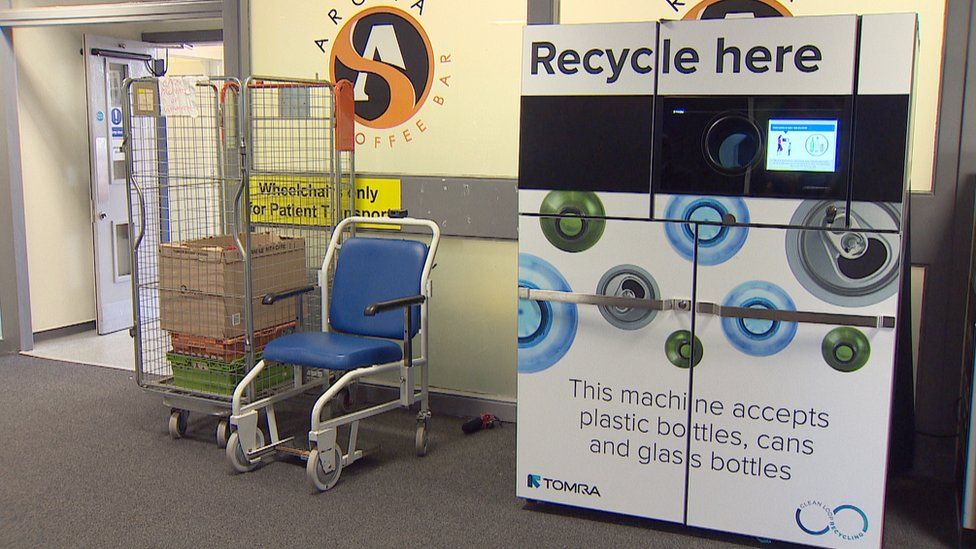
Reverse vending machines (RVMs), which are automated receiving points, are operated by larger stores, malls, and community hubs. Some retailers accept goods over the counter.
Cash can be paid in person over the counter or with a voucher obtained from an RVM. You have the option of asking for cash instead of vouchers when you go shopping.
The delivery of the program is the responsibility of the manufacturers and importers of alcoholic beverages, but to assist them, Circularity Scotland, a private non-profit organization, has been established to manage it on their behalf.
Although producers have the option to manage the program themselves, working with Circularity Scotland will typically be more cost-effective.
By running the container return points, retailers can play a significant role as well.
In more detail, the scheme works as follows: Producers are charged 20p by the administrator for each bottle or can they place on the Scottish market, but they recover this cost by including it in the price of their goods.
This 20p deposit is transferred further along the supply chain, via wholesalers and retailers, and ultimately to the customer, who receives it back when the product is turned in for recycling.
The administrator also levies a small fee on producers to help defray the cost of providing the service - about 2p for plastic or aluminum bottles and 4p for glass bottles - for each item.
Retailers will receive a small handling fee from Circularity Scotland for serving as return points, ranging from 2p to 3p per item depending on the collection method.
Retailers pay customers for recycled goods with their own money, but the administrator reimburses them.
The program is intended to be largely self-financing and applies to all beverage manufacturers who sell their goods in Scotland.
Sepa, the Scottish Environment Protection Agency, will serve as the regulating body and conduct inspections to ensure compliance.
The plan was initially set to begin in July 2022 and was first announced in 2019. However, this date was pushed back after a review determined that it was "unachievable," with Covid disruption being cited as the reason.
According to the current schedule, operations will begin on August 16, 2023.
Producers must register with Sepa and pay a flat registration fee of £365 by the end of February.
They can do this through Circularity Scotland, but if they do so, they should register sooner.
Some companies worry that it will add to their already heavy financial and administrative burdens.
Craft breweries and other small producers say they are not opposed to the concept in principle, but they caution that the scheme's timetable and other specifics are problematic.
Producers are urged to label products intended for sale in Scotland with a unique Scottish barcode; if they choose not to, they will be charged an additional fee of just over 1p per item.
Smaller businesses claim that the cost of implementing new barcodes or paying a flat registration fee will disproportionately affect them.
Retailers may request an exemption from offering a collection service, but only if they can show that another collection location in the area is willing to accept materials on their behalf or if collecting the materials would be against other regulations relating to fire safety or environmental health.
They are concerned their cash flow will be impacted by having to pay producers higher prices but then having to wait longer to get their money back from customers.
The Scottish plan would result in different prices being charged on either side of the border, according to a prominent lawyer who recently claimed that this could create an illegal trade barrier with other regions of the UK.
Additionally, Aidan O'Neill KC issued a warning that it might be impossible to enforce the laws regarding imported goods, which would disadvantage producers in Scotland.
In 2025, comparable programs are expected to be implemented in England, Wales, and Northern Ireland (although in England, glass bottles are not anticipated to be a part of the program).
The Scottish government maintains that it is taking concerns seriously, but some now contend that it would be better to postpone the Scottish scheme once more to give more time for planning and better alignment with the rest of the UK.
Lorna Slater, minister of the circular economy, expresses her confidence that the program won't be suspended.
She said on the The Nine program of BBC Scotland: "Scotland's deposit return scheme is such a crucial component of how we combat the blight of litter on our streets and in our parks and how we reach net zero. Additionally, we gave businesses a full extra year to get ready after COVID last year. So, I have no doubt that this year's launch in August will be successful.
The UK government and we have been collaborating on this program for years. The UK government fully supports the environmental goals of the Scottish Deposit Return Scheme and is committed to ensuring that it operates effectively, according to correspondence I just received from the UK Treasury last week that clarifies the VAT rules.
We're currently working to help businesses join the program by the deadline, but we've always said we'd adopt a practical approach to ensure that businesses have the knowledge they need and can fully take part in this program.
. "